
Recycling Isn’t Enough: Why Energy Needs a Second Life
Recycling has become a familiar sustainability story.
Across industries, organizations proudly report how much material they divert from landfills. And while recycling is essential, it’s only part of the solution—especially when it comes to energy infrastructure.
In the energy transition, recycling alone is not enough.
If we recycle too early, we destroy value that could have powered communities, stabilized grids, and strengthened resilience for years.
That’s why circular energy doesn’t start with recycling.
It starts with second life.
The Problem with a Recycling-First Mindset
Recycling is often treated as the default “responsible” action. When energy assets are retired, the assumption is that processing them for materials is the best outcome.
But recycling a functional battery or energy system too early comes at a cost:
-
Lost usable capacity
-
Increased demand for new manufacturing
-
Higher total lifecycle emissions
-
Greater pressure on material supply chains
Recycling recovers materials.
Second life preserves systems.
That difference matters.
What “Second Life” Really Means for Energy
Second life is not reuse without structure. It’s not risky redeployment. It’s a disciplined process of extending asset value through proper evaluation and remanufacturing.
In a second-life model:
-
Batteries are tested and graded
-
Systems are redesigned for new use cases
-
Performance expectations are matched to demand
-
Safety and reliability are engineered into the next deployment
The goal is not to push assets beyond their limits, but to place them where they make the most sense.
Why Second Life Preserves More Value Than Recycling
Every energy asset represents more than raw materials.
It contains:
-
Embedded manufacturing energy
-
Supply chain effort
-
Transportation and logistics investment
-
Engineering and assembly work
Recycling captures only a fraction of that value.
Second-life systems preserve:
-
Functional energy storage
-
Structural components
-
Integrated electronics
-
Existing system intelligence
From an economic and environmental standpoint, extending use almost always outperforms early material recovery.
Where Recycling Fits in the Circular Energy Model
Recycling remains critical—but timing is everything.
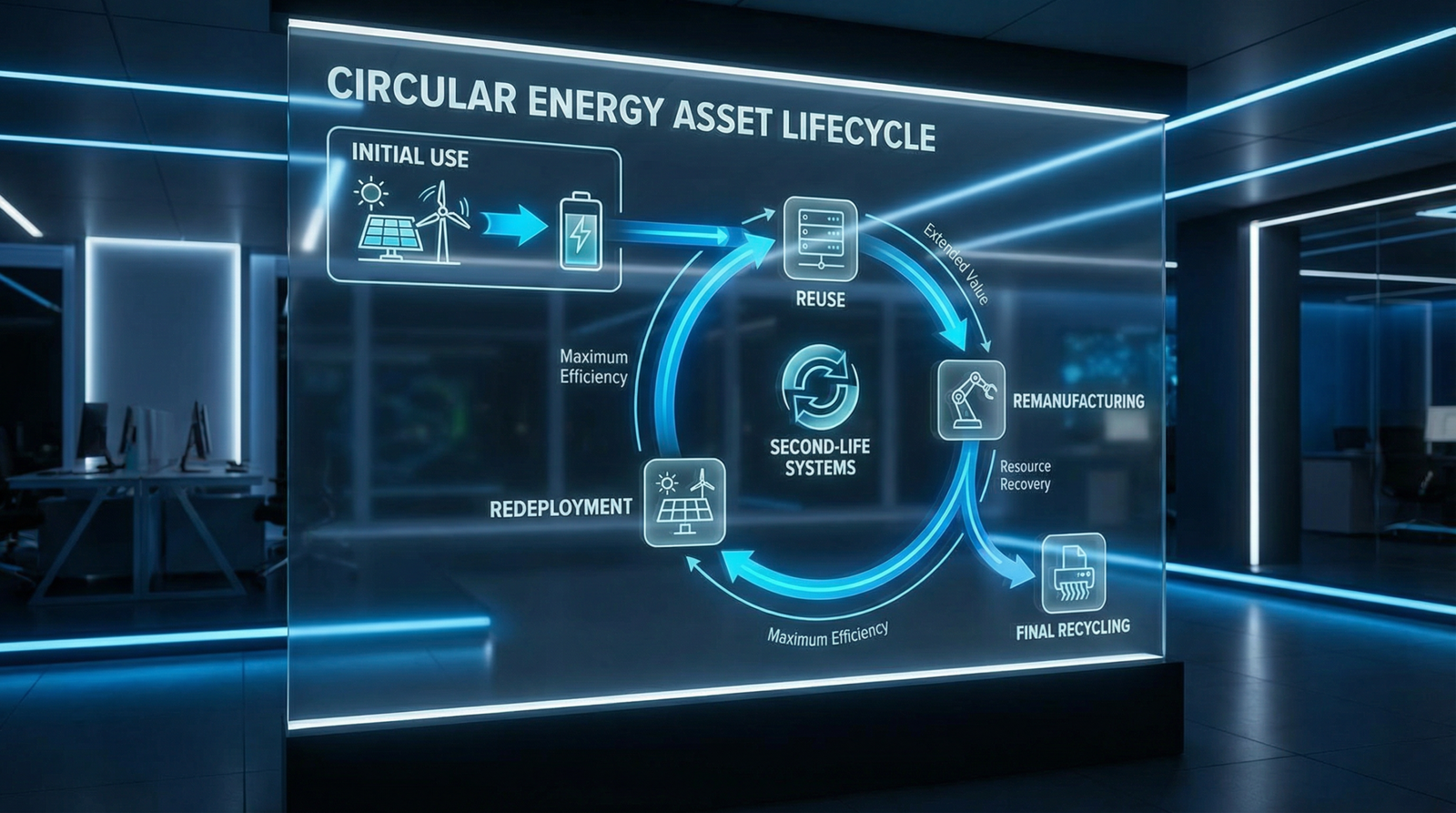
In a true circular energy system:
-
Assets are used in their primary role
-
They are repurposed through second-life deployment
-
Only then are they recycled at true end-of-life
This sequencing:
-
Maximizes return on investment
-
Minimizes environmental impact
-
Reduces waste volume
-
Stabilizes material supply chains
Recycling becomes the final safeguard, not the first response.
The Risk of Skipping Second Life
When second-life pathways don’t exist, organizations face hidden risks:
Financial loss
Functional assets are written off prematurely, increasing replacement costs.
Supply constraints
New energy storage demand grows faster than manufacturing capacity.
Sustainability gaps
ESG reporting focuses on recycling percentages but misses lifecycle optimization.
Infrastructure inefficiency
Energy systems are rebuilt instead of extended.
As energy storage becomes essential infrastructure, these inefficiencies compound quickly.
Second Life Makes Energy Systems More Resilient
Second-life energy systems shine in applications where reliability matters more than peak performance.
They are ideal for:
-
Backup power and resilience systems
-
Off-grid and remote energy deployments
-
Microgrids and distributed infrastructure
-
Fleet power and charging support
-
Temporary and mobile energy needs
In these roles, second-life systems:
-
Deploy faster
-
Cost less
-
Reduce waste
-
Improve system flexibility
Resilience isn’t just about strength—it’s about adaptability.
Why Second Life Is Finally Scaling
Second-life energy has existed for years, but adoption is accelerating now because the ecosystem is catching up.
Key drivers include:
-
Mature battery diagnostics and testing
-
Improved remanufacturing processes
-
Stronger logistics and recovery networks
-
Growing pressure to reduce waste
-
Rising energy storage demand
Second life is no longer experimental. It’s becoming infrastructure.
Designing Energy Systems That Expect a Second Life
The next evolution of circular energy is proactive design.
Energy systems built with second life in mind:
-
Use modular architectures
-
Enable easier diagnostics
-
Support disassembly and reconfiguration
-
Simplify redeployment into new applications
When systems are designed for recovery from day one, second life becomes smoother, safer, and more predictable.
Beyond Recycling Metrics
Measuring sustainability solely by recycling rates misses the bigger picture.
Circular energy success should be measured by:
-
Total lifecycle extension
-
Value recovered before recycling
-
Reduction in new manufacturing demand
-
Improved system uptime and resilience
-
Lower total cost of ownership
Second life is how sustainability moves from optics to outcomes.
Energy That Doesn’t Stop at Disposal
The energy transition isn’t just about how power is generated. It’s about how infrastructure is managed over time.
Recycling is necessary—but it’s not the goal.
Second life is where circular energy delivers its greatest impact.
By extending the usefulness of energy assets before recycling them, we build systems that are cleaner, smarter, and far more efficient.
Energy shouldn’t end when its first job is done.
It should keep going—stronger, longer, and ready for what comes next.