
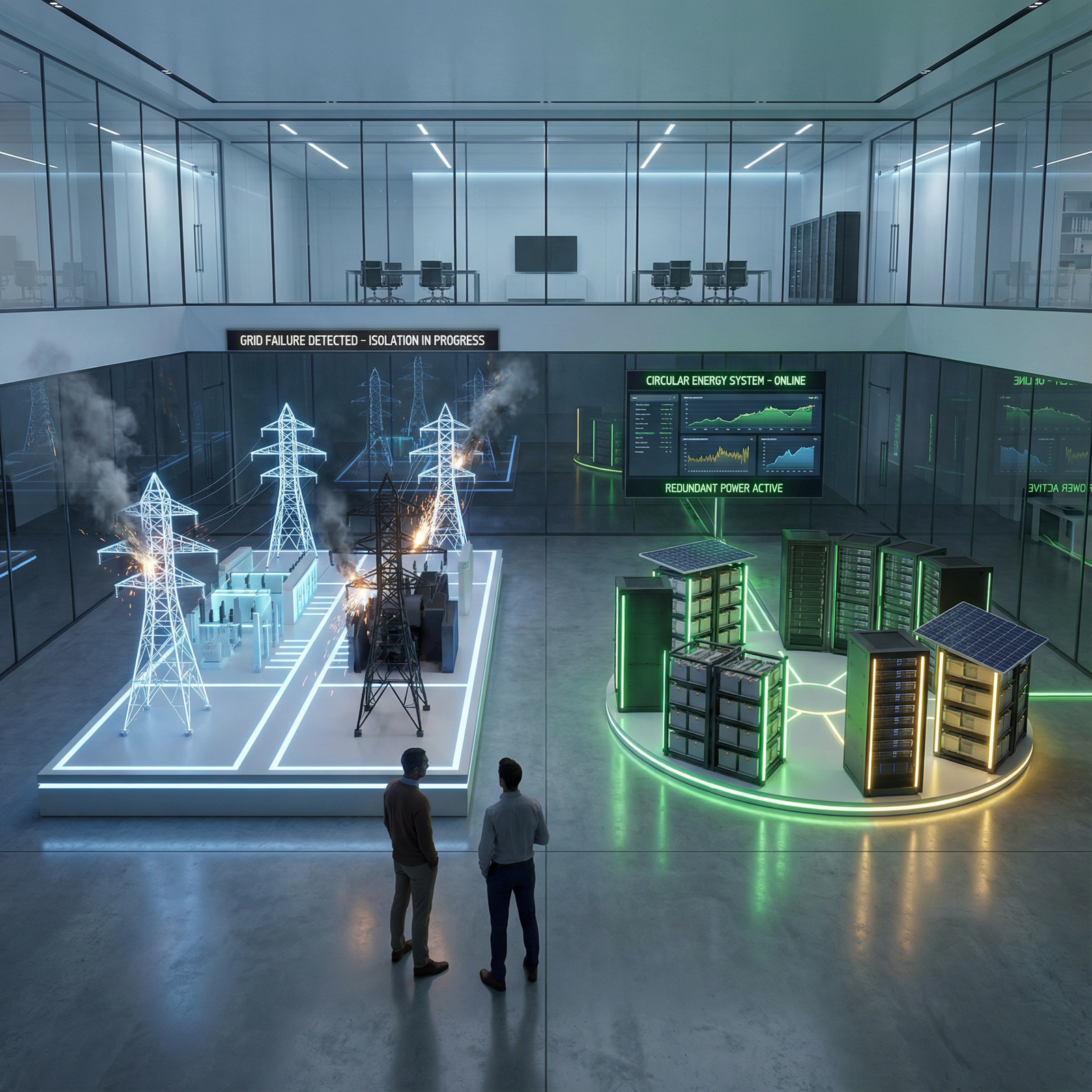
How Circular Energy Reduces Grid Risk and Improves Resilience
Grid reliability is no longer a given.
Extreme weather, aging infrastructure, rising demand, and electrification are pushing power systems to their limits. Outages that once lasted hours now stretch into days, affecting everything from emergency services to supply chains and public safety.
Resilience has become the new benchmark for modern energy systems.
And circular energy plays a critical role in achieving it.
The Growing Risk Facing Power Infrastructure
Today’s grid faces challenges it wasn’t designed for:
-
Increased load from electrification
-
Intermittent renewable generation
-
Aging transmission and distribution assets
-
Climate-driven weather events
-
Supply chain constraints for new equipment
Traditional grid expansion alone can’t keep up. Building new infrastructure takes time, capital, and permitting—resources that are often limited during periods of rapid change.
Circular energy offers a complementary path forward by making better use of assets already in circulation.
What Resilience Really Means
Resilience isn’t just about preventing outages. It’s about how systems respond when disruption occurs.
A resilient energy system can:
-
Absorb shocks
-
Isolate failures
-
Maintain critical operations
-
Recover quickly
Circular energy strengthens resilience by adding redundancy, flexibility, and distributed capacity without relying solely on new builds.
Distributed Energy Reduces Single Points of Failure
Centralized grids fail catastrophically when key assets go offline. Circular energy supports a more distributed approach.
Through:
-
Battery energy storage systems (BESS)
-
Microgrids
-
Second-life energy storage
-
Modular backup systems
Power can be generated, stored, and deployed closer to where it’s needed.
When part of the grid fails, these systems can:
-
Island from the main grid
-
Continue serving critical loads
-
Prevent cascading outages
Distributed energy doesn’t replace the grid—it reinforces it.
Second-Life Energy as a Resilience Multiplier
Second-life battery systems play a unique role in resilience planning.
Because they cost less and deploy faster than new systems, they enable:
-
More backup coverage across facilities
-
Redundant storage layers
-
Temporary or mobile power deployments
-
Rapid response during emergencies
This allows organizations to build depth into their resilience strategy, not just capacity.
In resilience planning, having more systems in more places often matters more than having the newest technology in one location.
Circular Energy Enables Faster Deployment
During emergencies, speed matters.
Circular energy systems benefit from:
-
Existing asset availability
-
Shorter manufacturing timelines
-
Modular and mobile designs
-
Pre-tested, redeployable components
This means power can be restored or reinforced faster—especially in disaster response scenarios where traditional infrastructure rebuilds take weeks or months.
Resilience isn’t just about strength.
It’s about responsiveness.
Reducing Risk Through Asset Recovery and Redeployment
Circular energy also reduces risk on the back end of infrastructure lifecycles.
Retired energy assets that are responsibly recovered and redeployed:
-
Reduce hazardous waste exposure
-
Minimize environmental and safety risks
-
Maintain compliance during decommissioning
-
Provide fallback capacity during system upgrades
Instead of becoming liabilities, retired assets become contingency resources.
Supporting Critical Infrastructure
Hospitals, data centers, water systems, communications networks, and emergency services all depend on continuous power.
Circular energy supports these systems by:
-
Providing reliable backup storage
-
Enabling localized microgrids
-
Reducing reliance on fuel-based generators
-
Improving uptime during grid disturbances
Second-life and modular systems allow critical infrastructure operators to expand resilience incrementally rather than waiting for large capital projects.
Resilience Without Unsustainable Costs
One of the biggest barriers to resilience investment is cost.
Circular energy lowers that barrier by:
-
Reducing upfront capital requirements
-
Extending asset lifecycles
-
Lowering total cost of ownership
-
Allowing phased deployment
This makes resilience accessible to:
-
Municipalities
-
Mid-sized enterprises
-
Remote facilities
-
Infrastructure operators with limited budgets
Resilience shouldn’t be a luxury. Circular energy helps make it standard.
A Smarter Way to Build Grid Stability
Circular energy doesn’t eliminate risk—but it changes how risk is managed.
By combining:
-
Distributed storage
-
Second-life systems
-
Responsible recycling
-
Modular infrastructure
Organizations build energy systems that adapt instead of breaking.
The grid becomes less brittle and more responsive.
Preparing for an Uncertain Energy Future
As demand grows and conditions become less predictable, resilience will define energy leadership.
Circular energy provides:
-
More options
-
Faster recovery
-
Better resource utilization
-
Reduced exposure to supply shocks
It transforms energy systems from rigid structures into flexible networks.
Power That Holds Up Under Pressure
The future grid won’t be defined by perfection—it will be defined by endurance.
Circular energy strengthens that endurance by ensuring power systems don’t rely on a single path, a single asset, or a single lifecycle.
By reducing waste, extending asset use, and deploying energy where it’s needed most, circular energy doesn’t just support the grid.
It helps it hold.