





Circular Energy in Action: Real-World Use Cases Across Cities, Fleets, and Remote Sites
Circular Energy in Action: Real-World Use Cases Across Cities, Fleets, and Remote Sites Circular energy
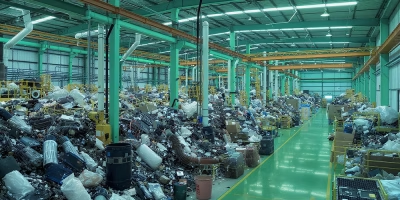
We work directly with city governments to implement comprehensive e-waste collection and processing programs. Our municipal partnerships in major metropolitan areas serve over 15 million residents, providing convenient drop-off locations and educational programs that increase recycling participation rates by 300%.
Our position as a critical link in the circular economy supply chain enables unique partnerships with manufacturers seeking sustainable sourcing solutions. We provide certified recycled materials that meet strict quality specifications while reducing supply chain risks and costs.
A regional government agency wanted to electrify part of its fleet and add public charging but didn’t have an internal energy team. Renew mapped priority sites, identified relevant state and federal incentives, and designed a phased implementation plan that made the program both fundable and operationally realistic within 18 months.
A regional shopping center had aging infrastructure and underused parking. Renew evaluated options for EV charging, solar, and storage, modeled revenue and incentive scenarios, and delivered a deployment plan that turned standard parking into a differentiated amenity and a new income stream.
A city began with a single pilot site. Renew helped standardize technical specifications, procurement paths, and internal workflows—transforming a one-off project into a repeatable template the city can now apply across dozens of facilities and corridors.
Here’s how Renew helps government agencies at the state and city level, along with property owners, move from plans on paper to projects in the ground.

Circular Energy in Action: Real-World Use Cases Across Cities, Fleets, and Remote Sites Circular energy

Designing Energy Systems That Don’t Become Waste The energy transition is building infrastructure at an

The Role of Battery Recycling in ESG, Compliance, and Reporting Sustainability is no longer a

How Circular Energy Reduces Grid Risk and Improves Resilience Grid reliability is no longer a

Recycling Isn’t Enough: Why Energy Needs a Second Life Recycling has become a familiar sustainability

The Hidden Value Inside Retired Energy Assets When energy equipment is retired, it’s often treated

Circular Energy in Action: Real-World Use Cases Across Cities, Fleets, and Remote Sites Circular energy

Designing Energy Systems That Don’t Become Waste The energy transition is building infrastructure at an

The Role of Battery Recycling in ESG, Compliance, and Reporting Sustainability is no longer a
How Circular Energy Reduces Grid Risk and Improves Resilience Grid reliability is no longer a
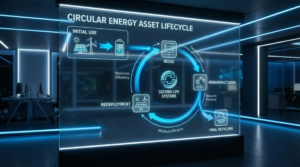
Recycling Isn’t Enough: Why Energy Needs a Second Life Recycling has become a familiar sustainability
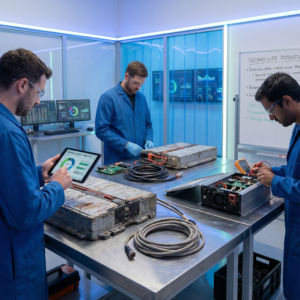
The Hidden Value Inside Retired Energy Assets When energy equipment is retired, it’s often treated
Rienu operates as an integrated ecosystem of specialized companies, each focusing on specific aspects of the circular economy while leveraging shared infrastructure, technology, and expertise.
Large-scale e-waste processing and IT asset management services for enterprise clients, handling over 10,000 tons of electronic waste annually through state-of-the-art facilities.
Research and development hub for next-generation sustainability technologies, partnering with universities and tech companies to pioneer breakthrough recycling and energy solutions.
Second-life battery systems and renewable energy integration, developing modular BESS solutions that provide grid-scale storage for utilities and commercial customers.
Specialized supply chain solutions for sustainable materials transport, offering secure, tracked movement of valuable components and materials across global networks.
From large-scale recycling programs to precision-refurbished energy systems, Rienu helps organizations cut waste, recover value, and build cleaner operations that last.
Share your needs—our experts will guide you to the right circular solution.
"*" indicates required fields
rienu.com
We firmly believe that the internet should be available and accessible to anyone, and are committed to providing a website that is accessible to the widest possible audience, regardless of circumstance and ability.
To fulfill this, we aim to adhere as strictly as possible to the World Wide Web Consortium’s (W3C) Web Content Accessibility Guidelines 2.1 (WCAG 2.1) at the AA level. These guidelines explain how to make web content accessible to people with a wide array of disabilities. Complying with those guidelines helps us ensure that the website is accessible to all people: blind people, people with motor impairments, visual impairment, cognitive disabilities, and more.
This website utilizes various technologies that are meant to make it as accessible as possible at all times. We utilize an accessibility interface that allows persons with specific disabilities to adjust the website’s UI (user interface) and design it to their personal needs.
Additionally, the website utilizes an AI-based application that runs in the background and optimizes its accessibility level constantly. This application remediates the website’s HTML, adapts Its functionality and behavior for screen-readers used by the blind users, and for keyboard functions used by individuals with motor impairments.
If you’ve found a malfunction or have ideas for improvement, we’ll be happy to hear from you. You can reach out to the website’s operators by using the following email
Our website implements the ARIA attributes (Accessible Rich Internet Applications) technique, alongside various different behavioral changes, to ensure blind users visiting with screen-readers are able to read, comprehend, and enjoy the website’s functions. As soon as a user with a screen-reader enters your site, they immediately receive a prompt to enter the Screen-Reader Profile so they can browse and operate your site effectively. Here’s how our website covers some of the most important screen-reader requirements, alongside console screenshots of code examples:
Screen-reader optimization: we run a background process that learns the website’s components from top to bottom, to ensure ongoing compliance even when updating the website. In this process, we provide screen-readers with meaningful data using the ARIA set of attributes. For example, we provide accurate form labels; descriptions for actionable icons (social media icons, search icons, cart icons, etc.); validation guidance for form inputs; element roles such as buttons, menus, modal dialogues (popups), and others. Additionally, the background process scans all the website’s images and provides an accurate and meaningful image-object-recognition-based description as an ALT (alternate text) tag for images that are not described. It will also extract texts that are embedded within the image, using an OCR (optical character recognition) technology. To turn on screen-reader adjustments at any time, users need only to press the Alt+1 keyboard combination. Screen-reader users also get automatic announcements to turn the Screen-reader mode on as soon as they enter the website.
These adjustments are compatible with all popular screen readers, including JAWS and NVDA.
Keyboard navigation optimization: The background process also adjusts the website’s HTML, and adds various behaviors using JavaScript code to make the website operable by the keyboard. This includes the ability to navigate the website using the Tab and Shift+Tab keys, operate dropdowns with the arrow keys, close them with Esc, trigger buttons and links using the Enter key, navigate between radio and checkbox elements using the arrow keys, and fill them in with the Spacebar or Enter key.Additionally, keyboard users will find quick-navigation and content-skip menus, available at any time by clicking Alt+1, or as the first elements of the site while navigating with the keyboard. The background process also handles triggered popups by moving the keyboard focus towards them as soon as they appear, and not allow the focus drift outside it.
Users can also use shortcuts such as “M” (menus), “H” (headings), “F” (forms), “B” (buttons), and “G” (graphics) to jump to specific elements.
We aim to support the widest array of browsers and assistive technologies as possible, so our users can choose the best fitting tools for them, with as few limitations as possible. Therefore, we have worked very hard to be able to support all major systems that comprise over 95% of the user market share including Google Chrome, Mozilla Firefox, Apple Safari, Opera and Microsoft Edge, JAWS and NVDA (screen readers).
Despite our very best efforts to allow anybody to adjust the website to their needs. There may still be pages or sections that are not fully accessible, are in the process of becoming accessible, or are lacking an adequate technological solution to make them accessible. Still, we are continually improving our accessibility, adding, updating and improving its options and features, and developing and adopting new technologies. All this is meant to reach the optimal level of accessibility, following technological advancements. For any assistance, please reach out to