
The Hidden Value Inside Retired Energy Assets
When energy equipment is retired, it’s often treated as a liability.
Decommissioned batteries, electronics, and power systems are labeled “end-of-life” and pushed toward disposal as quickly as possible. But in reality, many of these assets still hold significant untapped value—financial, operational, and environmental.
The problem isn’t the assets.
It’s how we’ve been trained to think about them.
Circular energy changes that perspective by asking a different question: What value is still inside this system?
Why Energy Assets Are Retired Before They’re Finished
Energy assets are rarely retired because they stop working. More often, they’re retired because:
-
Performance requirements change
-
Infrastructure is upgraded or modernized
-
Fleets are refreshed on fixed schedules
-
Warranty or risk thresholds are reached
-
Technology standards evolve
In many cases, the asset still performs reliably—it just no longer fits its original role. That gap between “no longer ideal” and “no longer useful” is where hidden value lives.
Batteries Are More Than Their First Job
Batteries are the clearest example of hidden energy value.
An EV battery removed from service might no longer deliver maximum range, but it can still:
-
Store and discharge energy reliably
-
Support lower-demand applications
-
Operate safely within new parameters
-
Deliver years of additional service
That remaining capacity represents stored value—value that’s lost when assets are prematurely recycled or discarded.
Second-life energy systems are how that value is unlocked.
What “Hidden Value” Actually Means
Hidden value shows up in three main ways:
1. Functional capacity
Remaining energy storage, usable electronics, and operational components that can be redeployed.
2. Material recovery
Metals and materials that retain market value when properly recovered through recycling.
3. Embedded infrastructure
Manufacturing, logistics, and embodied energy already invested in the asset.
Circular energy strategies aim to preserve all three—not just one.
The Role of Diagnostics and Evaluation
Unlocking hidden value requires more than good intentions. It requires visibility.
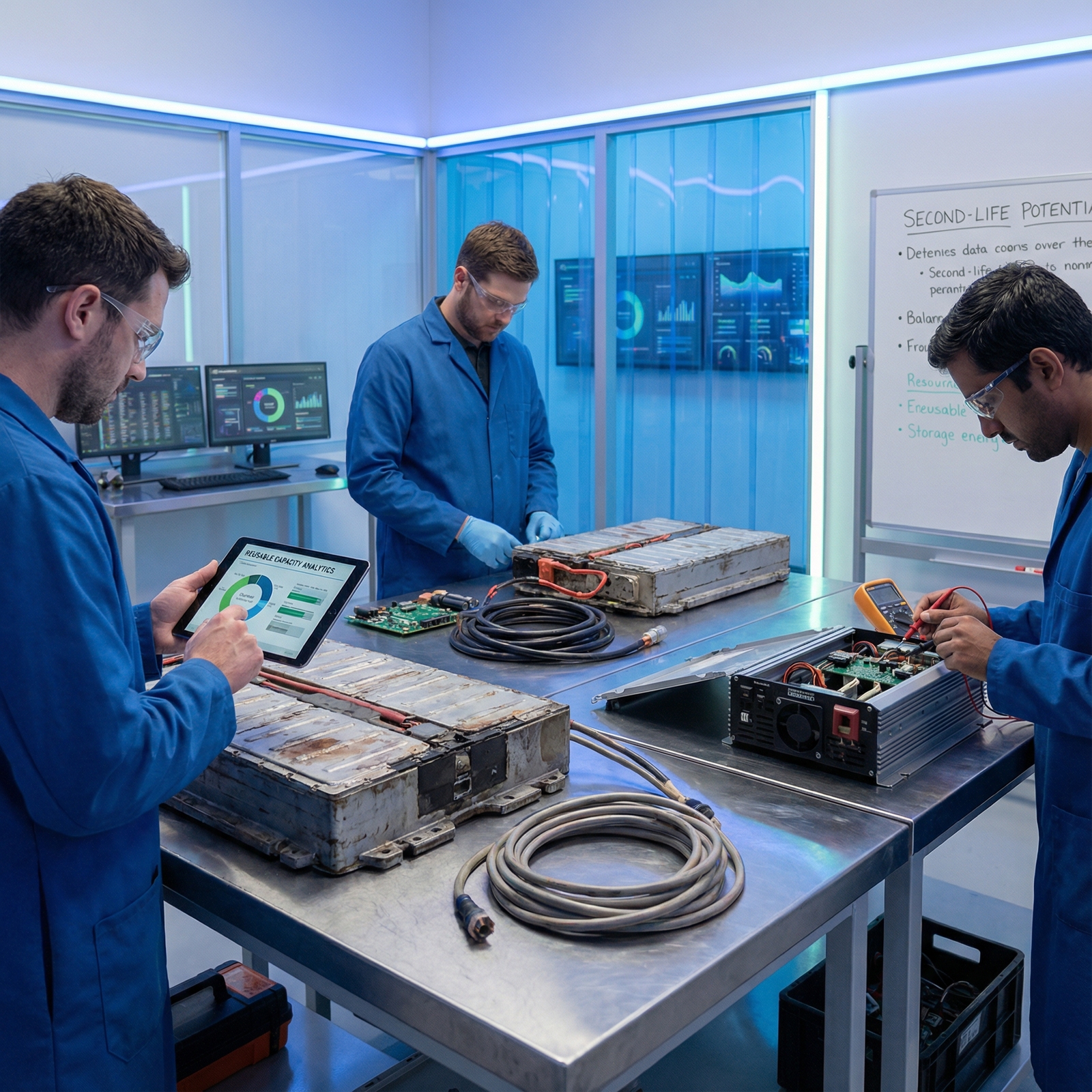
Modern circular energy systems use diagnostics and evaluation to determine:
-
Battery health and remaining capacity
-
Module and cell performance
-
Safety and thermal stability
-
Suitability for second-life applications
-
End-of-life readiness for recycling
This evaluation step is critical. Without it, assets are either overused (creating risk) or underused (leaving value on the table).
From Retired Asset to Redeployed System
Once evaluated, energy assets can take multiple paths:
-
Direct reuse in lower-demand applications
-
Remanufacturing into modular energy systems
-
Component harvesting for refurbishment
-
Recycling for material recovery
The goal isn’t to force every asset into reuse—but to match each asset with the highest-value outcome available.
That decision-making process is what separates circular energy from basic recycling.
Why Enterprises Are Paying Attention
Enterprises are beginning to see retired energy assets not as waste—but as balance-sheet opportunities.
Circular energy programs help organizations:
-
Recover value from retired equipment
-
Reduce disposal and compliance costs
-
Improve ESG performance
-
Document responsible asset management
-
Support internal sustainability goals
Instead of paying to dispose of assets, organizations can extract measurable returns—financial and reputational.
The Cost of Ignoring Hidden Value
Failing to capture hidden value comes with real consequences:
-
Higher replacement costs for new energy systems
-
Increased landfill and environmental impact
-
Greater exposure to material supply volatility
-
Missed sustainability benchmarks
-
Lost opportunity for resilience and redeployment
As energy storage demand rises, ignoring recoverable value becomes harder to justify.
Circular Energy Turns Waste Streams Into Value Streams
Circular energy reframes the entire lifecycle of power infrastructure.
Rather than seeing retirement as the end, it becomes a transition point—one where value shifts from first use to second life, and eventually to material recovery.
This approach:
-
Extends asset lifespans
-
Reduces raw material demand
-
Stabilizes energy supply chains
-
Improves long-term economics
Hidden value isn’t theoretical. It’s measurable, recoverable, and increasingly essential.
Designing Systems With Recovery in Mind
The next evolution of circular energy is proactive—not reactive.
Energy systems designed with recovery in mind:
-
Use modular components
-
Support easier diagnostics
-
Enable safer disassembly
-
Simplify redeployment and recycling
When recovery is planned from the start, value extraction becomes easier, safer, and more predictable.
Seeing Energy Assets Differently
The shift to circular energy begins with perspective.
Retired energy assets aren’t failures. They’re partially completed value cycles.
By investing in recovery, evaluation, and redeployment, organizations turn what was once a cost center into a strategic advantage.
The hidden value inside retired energy assets isn’t hidden anymore.
The only question is who’s prepared to capture it.